Choosing an LED channel diffuser starts with the lighting effect your customer needs. Should the installation deliver a bright, discreet light source under a shelf, or show a soft line of light across a ceiling? The cover changes how the LED strip looks, how light spreads and how much light passes through the material.
Union Opto offers clear, frosted, diffusing and opal white cover options for compatible LED aluminum profiles. This guide compares the four sample appearances, explains how they work with SMD and COB strips, and shows what to check before ordering.
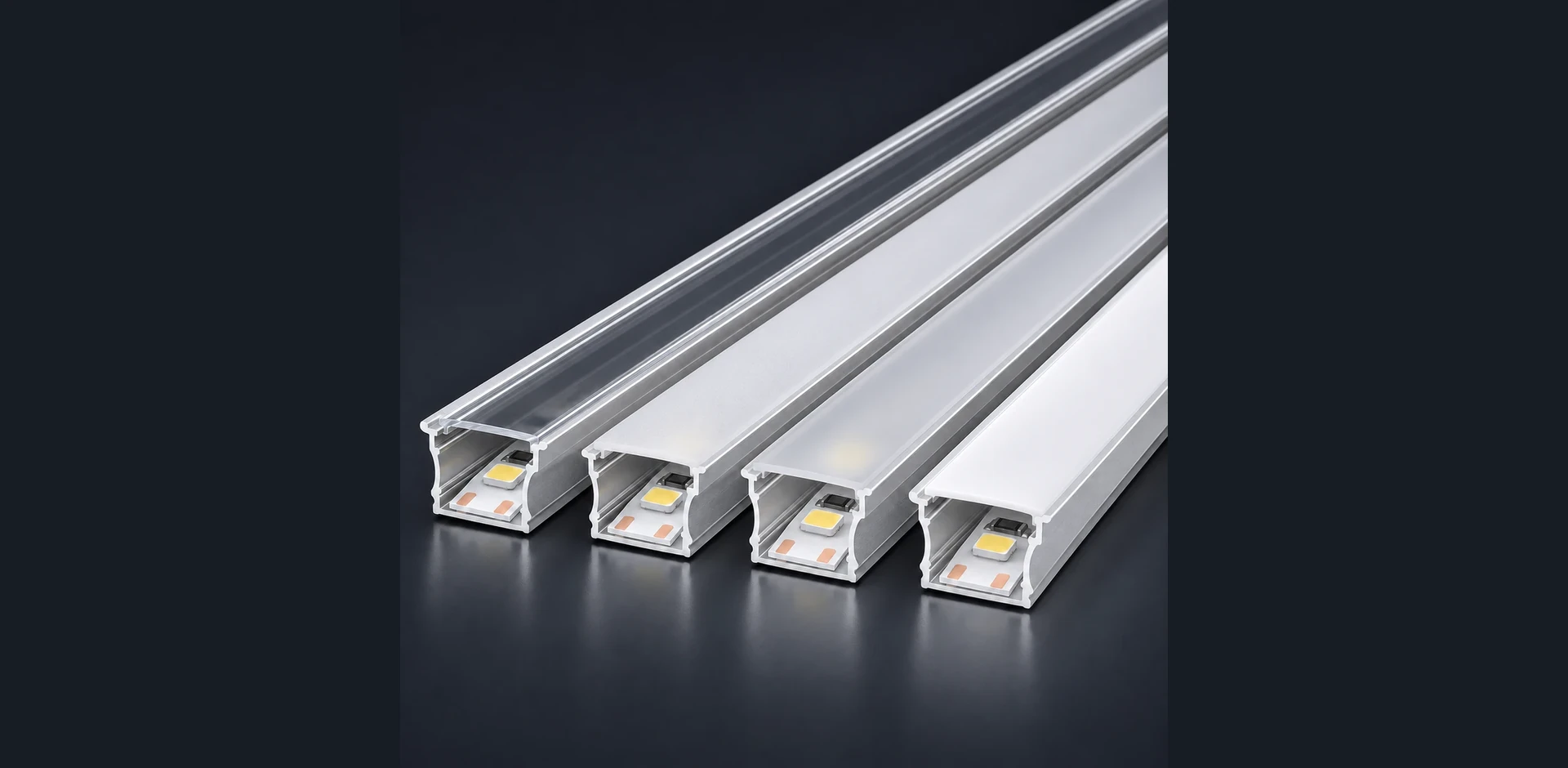
Cover options from left to right: clear, frosted, diffusing and opal white. Product visualization.
Which LED Channel Cover Should You Choose?
For the four Union Opto covers shown here, the relative light transmission is clear > diffusing > frosted ≈ opal white. The frosted and opal white options have similar transmission; their surface texture and appearance differ.
| Your priority | Start with | What to check |
|---|---|---|
| High light transmission and a visible light source | Clear cover | Direct view of the LEDs and reflections on glossy surfaces |
| Higher transmission with some light diffusion | Diffusing cover | Balance of useful output and visible LED detail |
| A matte finish with stronger softening | Frosted cover | Uniformity and matte appearance; transmission is similar to opal white |
| A milky white finish and concealed internal components | Opal white cover | Light output and the finished appearance when switched on and off |
Use this as a starting point, then select the cover together with the LED strip and aluminum profile. A cover that works well in a deep ceiling profile may look different in a shallow cabinet channel.
Clear vs Frosted vs Diffusing vs Opal White Covers
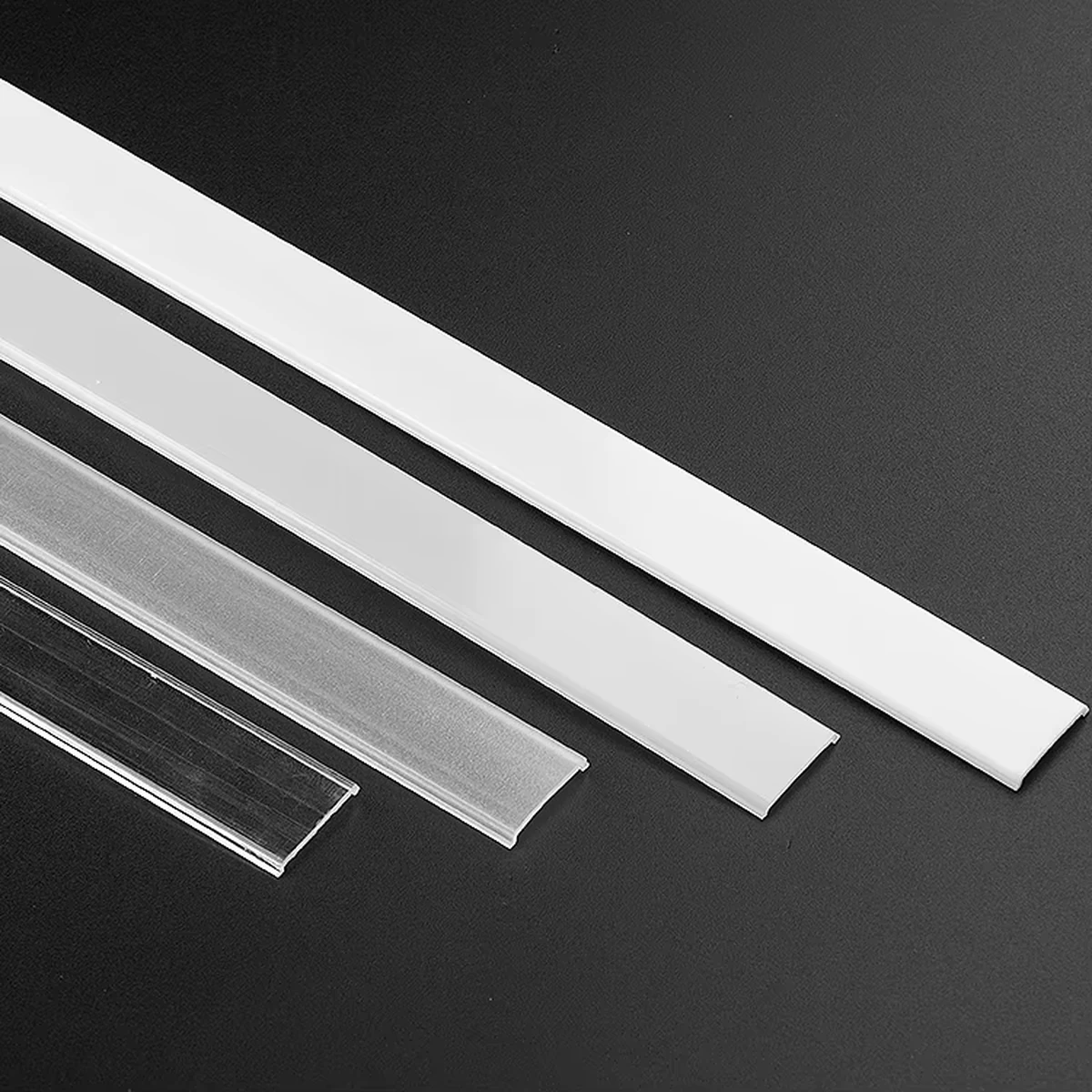
Four cover samples supplied by Union Opto: clear, frosted, diffusing and opal white.
Clear Cover: Keep the Light Source Visible
A clear cover has a transparent appearance. It is a practical choice when high transmission matters and the installed channel is hidden from normal view. Customers can see the LED strip through the cover, including individual SMD packages or the continuous phosphor line of a COB strip.
Consider clear covers for concealed shelf lighting, indirect lighting and luminaires with separate optical control. If the channel faces the viewer or a reflective worktop, review the visible light source before confirming the selection.
Frosted Cover: Soften the Appearance of LED Points
The frosted sample has a matte, translucent surface. It softens the view of the strip with light transmission similar to the opal white option. Depending on LED spacing and the distance between strip and cover, individual points may still be visible.
This is a useful starting point for cabinet, wardrobe and shelf lighting when the customer wants a matte surface and a softened light source. Check it with the actual strip, especially in shallow channels.
Diffusing Cover: Blend the Light Across the Cover
The diffusing sample is the third option in our four-cover selection. It provides some light spreading while transmitting more light than the frosted and opal white options, and less than the clear option. Consider it when you want a balance between light transmission and a softened view of the strip.
For retail displays, furniture and visible linear lighting, compare the illuminated surface from the direction customers will normally see it. The balance between blending and transmission depends on the selected cover formulation and thickness.
Opal White Cover: Create a Milky White Finish
An opal white cover has a milky appearance that conceals more of the internal strip when switched off. It is a common choice for visible architectural lighting lines, office interiors and furniture where the appearance of the luminaire matters as much as the light on nearby surfaces.
Pair it with a suitable strip and optical mixing distance to achieve the required uniformity. Confirm the finished light output when the installation also needs to provide task lighting.
Ordering note: “Diffuser” is also a general name for a light-spreading cover. In this guide, “diffusing cover” identifies the third sample, separately from the frosted and opal white samples. Match repeat orders to the approved sample and cover specification.
How Much Light Passes Through the Cover?
Union Opto supplies the following reference light-transmission ranges for the cover options in this guide:
| Cover type | Reference light transmission |
|---|---|
| Clear PC cover | 80–95% |
| Diffusing PC cover | 75–85% |
| Frosted PC cover | 60–65% |
| Opal white PC cover | 60–65% |
Clear offers the highest transmission option, followed by diffusing. The clear and diffusing ranges overlap, so compare the selected specifications when an exact optical requirement matters. Frosted and opal white share the same reference range; choose between them for surface texture and the desired appearance. For housing finishes and other customization options, see our custom LED aluminum profile guide.
Transmission describes the light passing through a cover under its specified measurement conditions. For example, a 60–65% transmission figure corresponds to approximately 35–40% not transmitted under those conditions. It is not automatically a 35–40% reduction in illuminance on a customer's desk: cover scattering, channel geometry and installation position also affect where the light goes.
For a procurement comparison, ask for the selected cover's transmission specification and compare assembled samples. To compare work-surface illuminance, use the same strip, input power, channel, mounting height and measurement positions, changing only the cover. Record both useful light output and visual uniformity.
SMD LED Strips: How the Cover Changes Visible Dots
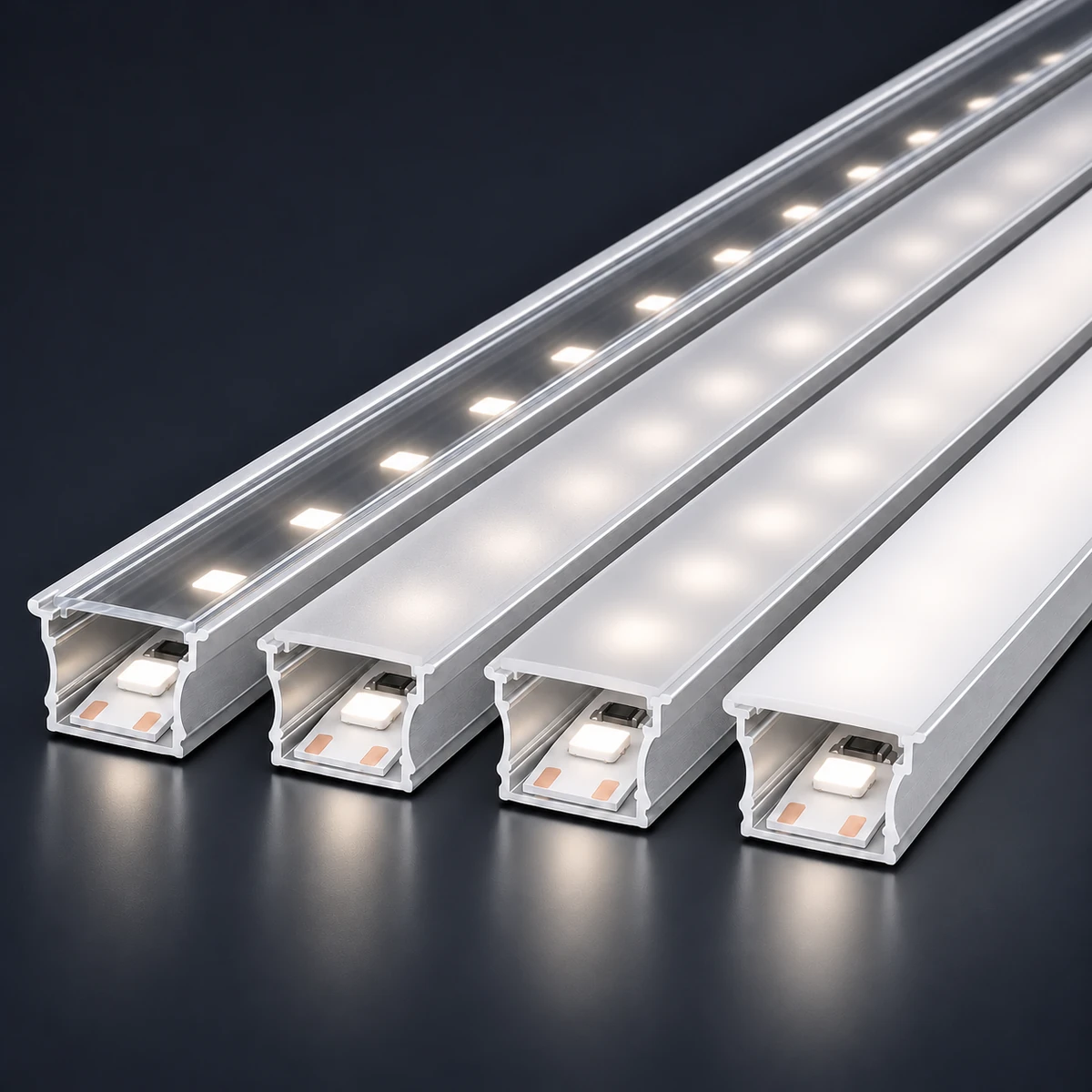
Illustrative lighting comparison. Left to right: clear, frosted, diffusing and opal white. The image explains diffusion rather than measured brightness.
SMD strips use separate LED packages. With a clear cover, these points remain easy to see. Frosted and diffusing covers soften their outlines, with the diffusing option retaining higher transmission than frosted and opal white. Frosted and opal white have similar transmission, and the appearance of LED points also depends on their scattering properties and the assembly.
If dots remain too obvious, review three things together: LED spacing, distance from the LEDs to the cover, and cover diffusion. A denser strip or a deeper optical chamber can improve blending. Increasing wattage alone does not solve the spacing between individual points.
For a shallow cabinet profile, compare a high-density SMD strip and a COB alternative before changing the channel design. For a visible ceiling line, give uniformity greater weight and check the result along the complete installed length. Our LED aluminum channel size guide explains how strip width and profile dimensions affect the assembly.
COB LED Strips: Choose the Cover for the Finished Appearance
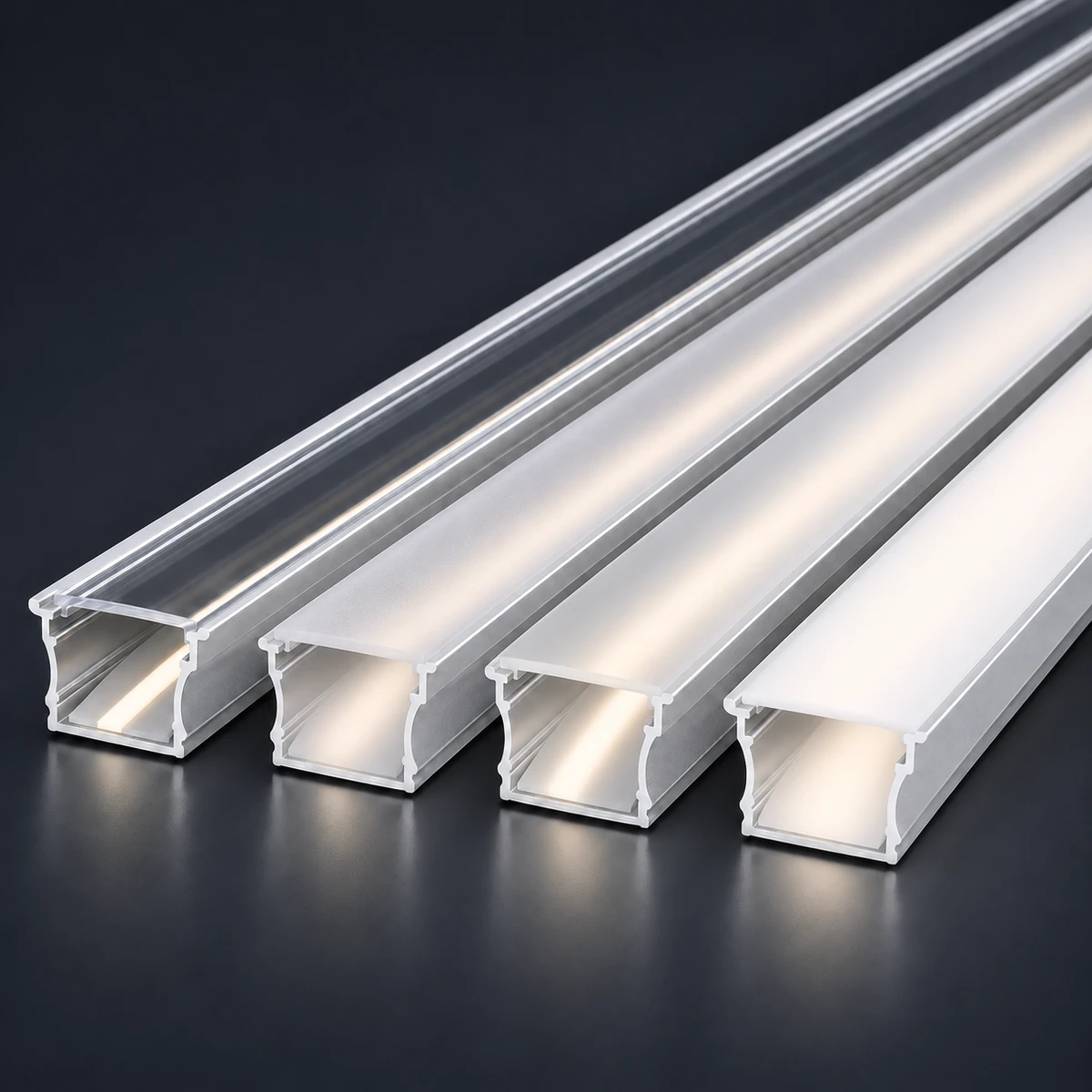
Illustrative lighting comparison. Left to right: clear, frosted, diffusing and opal white.
A COB strip typically presents a more continuous luminous line than a strip with widely spaced SMD packages. This gives buyers more flexibility when choosing the cover. A clear cover keeps the narrow light source visible. The diffusing option balances transmission and softening; frosted and opal white provide alternative surface appearances with similar transmission.
For concealed COB lighting, start by considering useful light output and protection of the strip. For a visible luminaire, compare the width and softness of the luminous line, the switched-off appearance and reflections on nearby materials. A cover can still improve the finished appearance even when individual LED dots are already difficult to see.
Check the Cover Fit Before Ordering
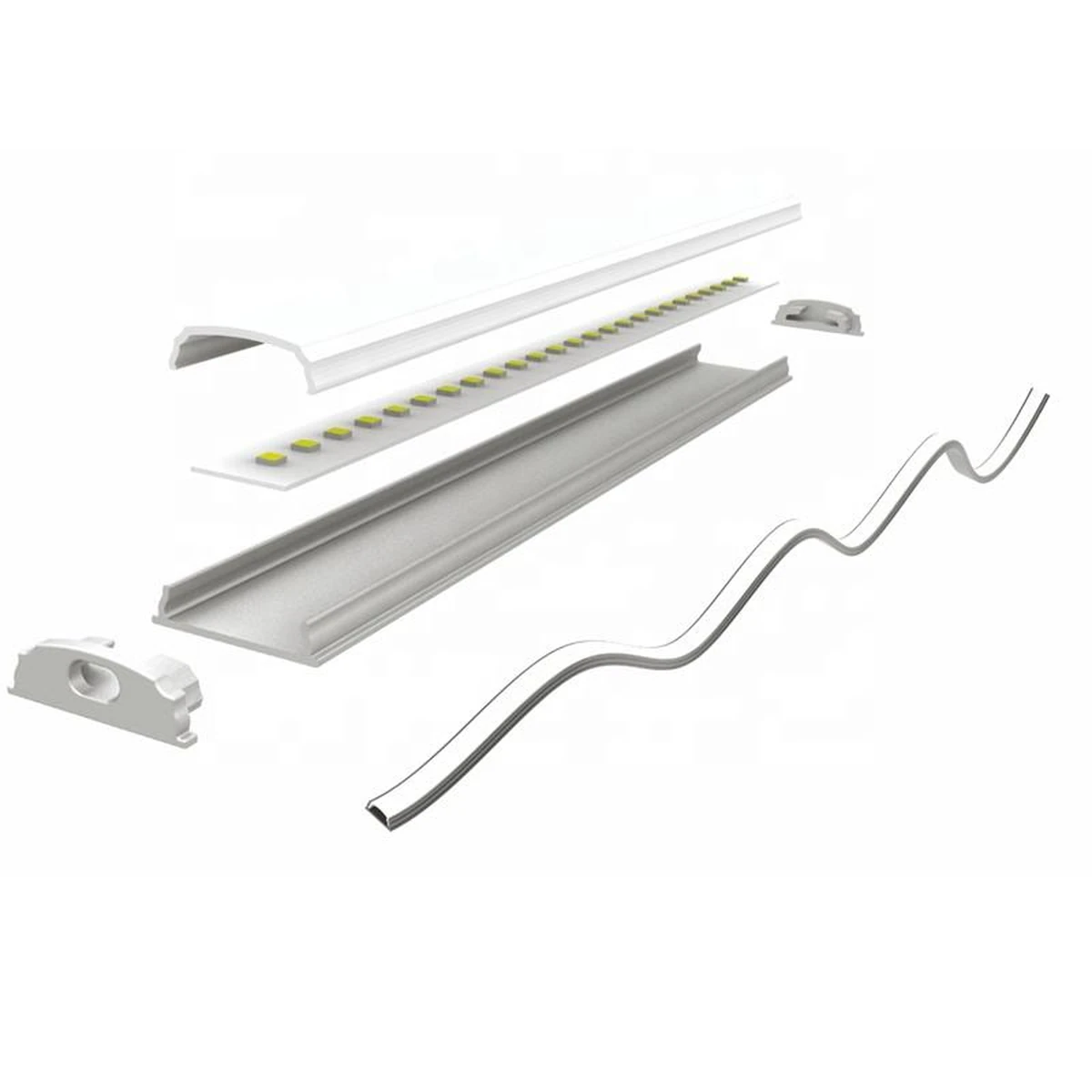
The cover and aluminum channel need matching engagement details. Two covers with similar overall widths may use different edge shapes, so width alone is insufficient for confirming compatibility.
Ask the supplier to confirm the profile model, cover code, engagement dimensions, cover shape and installation method. Some covers snap into the channel from above; others slide in from the end. Plan end-cap installation and access for future maintenance accordingly.
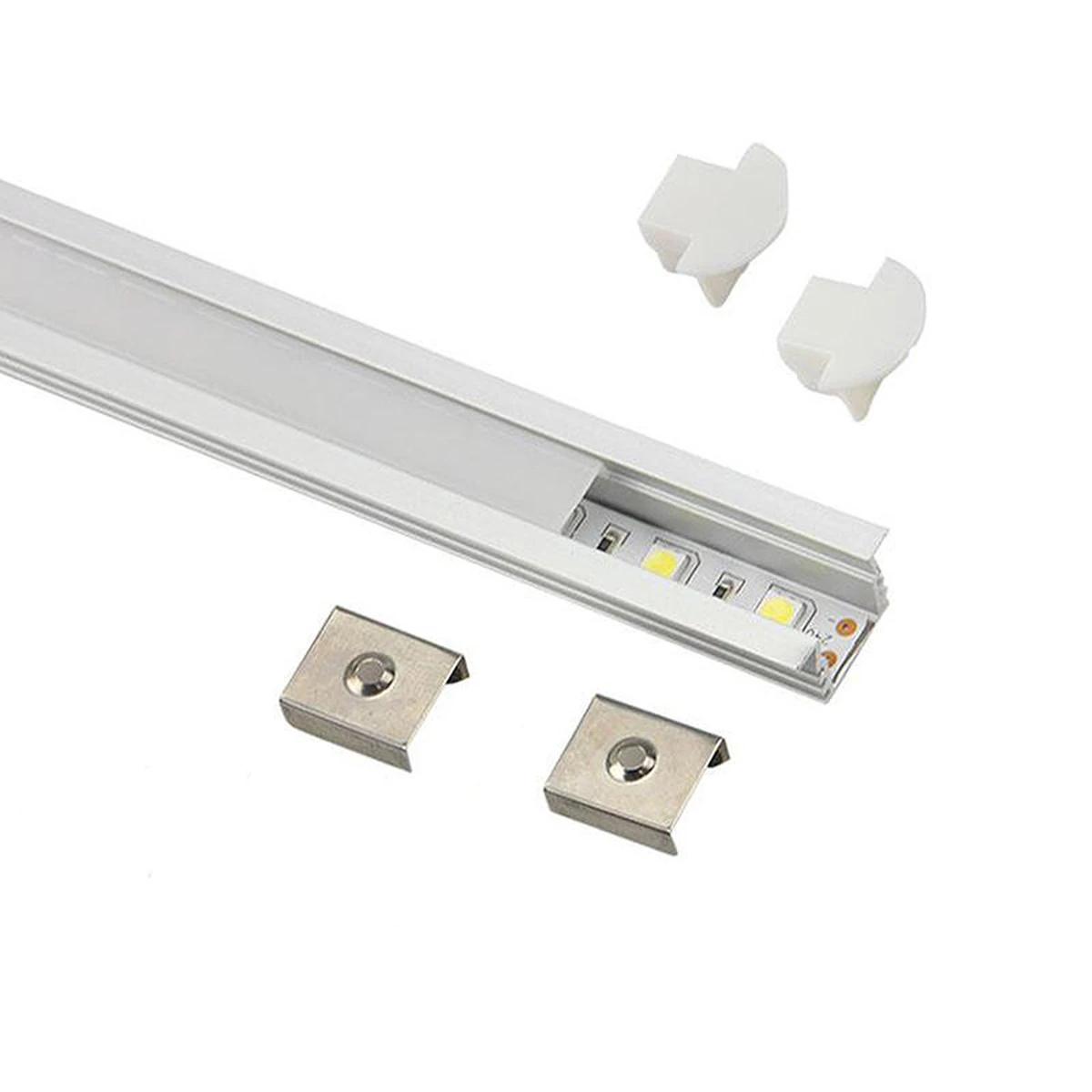
Check an assembled sample for secure engagement, even seating along the length, clean end cuts and compatibility with the end caps. Confirm that clips or screws do not interfere with the strip or cover. For curved lighting, select a compatible flexible cover and bending profile as a system; see our bendable LED aluminum channel collection.
A Practical Selection Process for B2B Buyers
- Define the application. State whether the channel is concealed or directly visible, and whether the light is decorative or used for a task.
- Confirm the strip. Provide SMD or COB type, strip width, LED density where applicable, power per meter and color temperature.
- Match the channel and cover. Confirm usable internal width, mixing distance, engagement structure and required length.
- Compare samples in the installation. Review switched-on uniformity, switched-off appearance and reflections at the intended viewing distance.
- Approve the specification. Record the profile model, cover code, material, finish, length and optical requirements for repeat orders.
For incoming checks, use our LED aluminum profile inspection checklist to review dimensions, surface finish, assembly and packaging.
Frequently Asked Questions
Is a frosted LED diffuser the same as an opal cover?
The terms can overlap between suppliers. In this four-sample selection, frosted refers to the matte translucent cover, while opal white refers to the milky white option. Their light transmission is similar in this product selection; a different appearance does not necessarily mean a large difference in transmitted light. Use a sample reference and cover code to communicate the required finish.
Will an opal cover remove all LED dots?
Choose the opal cover together with strip density and the distance between the LEDs and cover. If the chosen assembly still shows dots, try a denser strip, a COB strip or a channel with more optical mixing space.
Can I use a clear cover with a COB strip?
Yes, when the cover fits the channel and the visible COB line suits the installation. Compare a diffusing option if the customer prefers a wider, softer luminous surface or a more concealed internal appearance.
Can I order replacement covers by width alone?
Provide the aluminum profile model or a dimensioned cross-section, plus a sample if available. The engagement edges and cover shape must match as well as the width.
Does a cover make the channel waterproof?
For a waterproof installation, specify a complete sealed lighting assembly with the required IP rating, compatible seals, end caps and cable entries. A standard fitted cover by itself is not an IP-rated enclosure.
Get the Right Cover for Your LED Aluminum Profile
Send Union Opto your profile drawing or model, LED strip specification, required length, order quantity and application photos. Tell us whether your priority is light output, a softer line of light or a milky white appearance. We can help select compatible aluminum profiles and covers for your lighting product or project.